How to count calories with a photo: a step-by-step guide
From setting your target to reviewing the scan, the eight steps that make photo logging fast and reliable.
Step 1: Set your daily target first
A calorie count only means something against a target. Cal.AI's setup asks for your goal (lose, maintain or gain), how fast, your activity level and your height, weight, age and sex. It then computes your daily calorie and macro targets using the Mifflin-St Jeor equation, the resting-energy formula that performed best in a review by the Academy of Nutrition and Dietetics (Frankenfield et al., 2005). You also get a projected goal date that updates as you log.
Step 2: Open the scanner
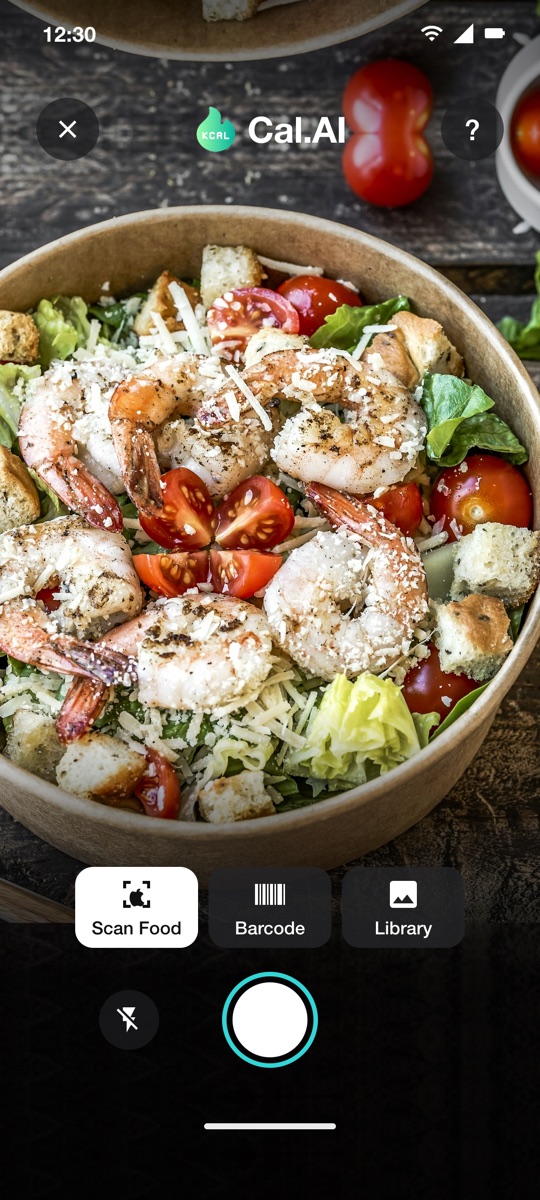
Tap the + button and choose Scan Food. Hold the phone slightly above the plate, not at table level. From above, the model sees every item and its relative size; from the side, items hide behind each other.
Step 3: Frame the whole plate in good light
- Keep every item inside the frame, with a little margin.
- Natural light or a bright room. Avoid strong shadows across the plate.
- Tap to focus if the image looks soft.
- Photograph before you mix the bowl or pour the sauce. Separate items are easier to estimate.
Step 4: Review the item list
The result screen shows each detected food with its calories, protein, carbs and fat, plus a total for the meal. Read the list the way you would read a receipt. Is anything missing? Is "chicken" actually "fried chicken"? Is the bread one slice or two?
Step 5: Fix anything that is off
Tap Fix Results. You can rename a food, swap an ingredient (whole milk for oat milk), or change the portion of any item. The − / + control changes the number of servings for the whole meal, useful for seconds. Totals recalculate instantly, and corrected items are saved so you can log them again in one tap next time.
Step 6: Add the invisible calories
No camera can see the oil the vegetables were roasted in or the sugar in your latte. The biggest hidden items, with typical values, so you can add them as separate entries:
| Hidden item | Typical amount | Approx. calories |
|---|---|---|
| Olive oil for cooking | 1 tablespoon | ~120 kcal |
| Butter on toast or vegetables | 1 tablespoon | ~100 kcal |
| Caesar or ranch dressing | 2 tablespoons | ~140–160 kcal |
| Sugar in coffee or tea | 1 teaspoon | ~16 kcal |
| Mayonnaise in a sandwich | 1 tablespoon | ~90 kcal |
Values are rounded averages from USDA FoodData Central; exact numbers vary by brand.
Step 7: Use the barcode for packaged food
For anything with a nutrition label, choose Barcode instead of a photo. The label values replace the visual estimate, so a protein bar or a yogurt is logged exactly as printed. If a product isn't in the database yet, search by name or enter it manually once; it is saved for next time.
Step 8: Check the weekly trend, not the single meal
Once a week, open Insights and compare your average daily intake with your weight trend. If the trend is moving at the pace you chose, the estimates are good enough. If it isn't, the fix is usually one of three things: a meal type you keep skipping, portions that are bigger than they look, or hidden calories from step 6. Adjust and keep going. Consistent self-monitoring is one of the best-supported habits in weight management research (Burke et al., 2011).


Common questions
Do I need to photograph every meal?
For the first two weeks, yes, including snacks and drinks. That is where most untracked calories hide. After that, repeat meals can be logged from your saved items in one tap.
What if I ate half the plate?
Scan the full plate first, then set the serving control to 0.5, or photograph the leftovers and log the difference. Either way, be consistent.
Can I log a meal I ate earlier?
Yes. Pick the photo from Library instead of the live camera, and change the meal time on the result screen.
Sources
- Frankenfield D, Roth-Yousey L, Compher C. Comparison of predictive equations for resting metabolic rate in healthy nonobese and obese adults: a systematic review. J Am Diet Assoc. 2005;105(5):775-789. PubMed
- Burke LE, Wang J, Sevick MA. Self-monitoring in weight loss: a systematic review of the literature. J Am Diet Assoc. 2011;111(1):92-102. PubMed
- USDA FoodData Central. fdc.nal.usda.gov